
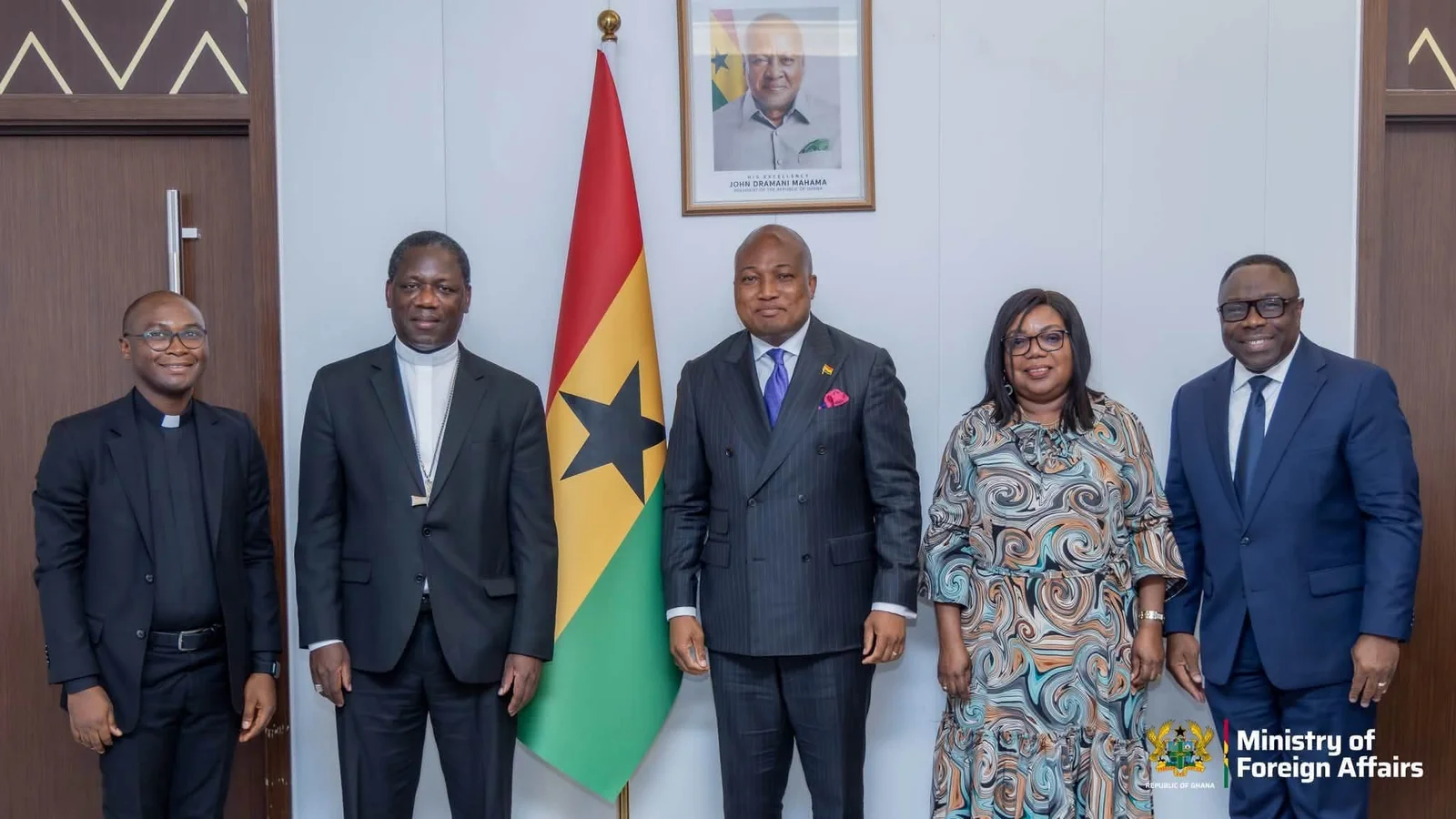
ACCRA — Fifty years after the first papal ambassador arrived in Accra, Ghana and the Holy See are finally close to signing off on the rulebook for their relationship.
Cabinet has approved the long-pending Host Country Agreement between the Government of Ghana and the Holy See, the sovereign authority of the Pope and the Catholic Church. The agreement now goes to Parliament for ratification.
Foreign Affairs Minister Samuel Okudzeto Ablakwa shared the news on Friday, October 9, 2026, during a meeting in Accra with the Apostolic Nuncio to Ghana, Archbishop Julien Kaboré, who represents Pope Leo XIV. The minister said the agreement had been pending ever since formal diplomatic ties led to the arrival of the first Apostolic Nuncio in Ghana in 1976.
What is a host country agreement?
A host country agreement is a formal treaty that sets the ground rules when a foreign state or international body keeps a diplomatic mission in another country. It typically covers the legal status of the mission, the protection of its premises and staff, and the rights and immunities its representatives enjoy.
According to the Foreign Affairs Minister, the Ghana–Holy See agreement:
- follows the 1961 Vienna Convention on Diplomatic Relations, the global treaty on how diplomatic missions operate
- sets out the terms of Ghana's relationship with the Holy See
- grants special rights, privileges and immunities to holders of ecclesiastical office and to the Catholic faithful in Ghana
The full text has not yet been made public. Its exact provisions are expected to become clearer when it is laid before Parliament.
Holy See or Vatican?
The two terms are often used interchangeably, but they are different. Vatican City is the tiny independent state in Rome. The Holy See is the governing authority of the Pope and the Catholic Church worldwide. It is the Holy See, not Vatican City, that holds diplomatic relations with countries like Ghana, and its embassy is called the Apostolic Nunciature, headed by an Apostolic Nuncio.
A relationship decades in the making
The Holy See's diplomatic presence in Ghana began in 1973, when Archbishop Girolamo Prigione was appointed Apostolic Delegate. Full diplomatic ties followed, and the first Apostolic Nuncio arrived in 1976.
For five decades, however, the host country agreement that should formally govern the relationship remained unfinished. Ablakwa said resolving it was a target he had set for his ministry, and he credited Foreign Ministry officials, President John Dramani Mahama and the Attorney-General for helping to get it over the line.
Recognising the Church's role
The minister used the occasion to pay tribute to the Catholic Church's role in Ghana, praising what he called its "extraordinary and monumental contributions" to the nation. He highlighted the Church's influence on the country's moral values and its role in building thousands of schools, hospitals and clinics across Ghana, especially in education and health.
What happens next
The agreement now goes to Parliament. Under Article 75 of the 1992 Constitution, international agreements signed by the President or on his behalf must be ratified by Parliament before they take full effect. The Foreign Affairs Minister expects that to happen within the next few weeks.
Once ratified, the agreement will close a diplomatic file that has stayed open for half a century, and give the relationship between Ghana and the Holy See a clear legal foundation.


Comments (0)
No comments yet.
Only registered users can comment.
Sign in or create a free account to join the discussion.